Atlas Minerals & Chemicals, Mertztown PA
Epoxybond hardens under water. Cut off what the crack needs, knead it until the color goes even, press it in and hold it there. No draining, no plaster drying for a week.
Rated 4.5 out of 5 across 5,024 ratings on the listings we link to.
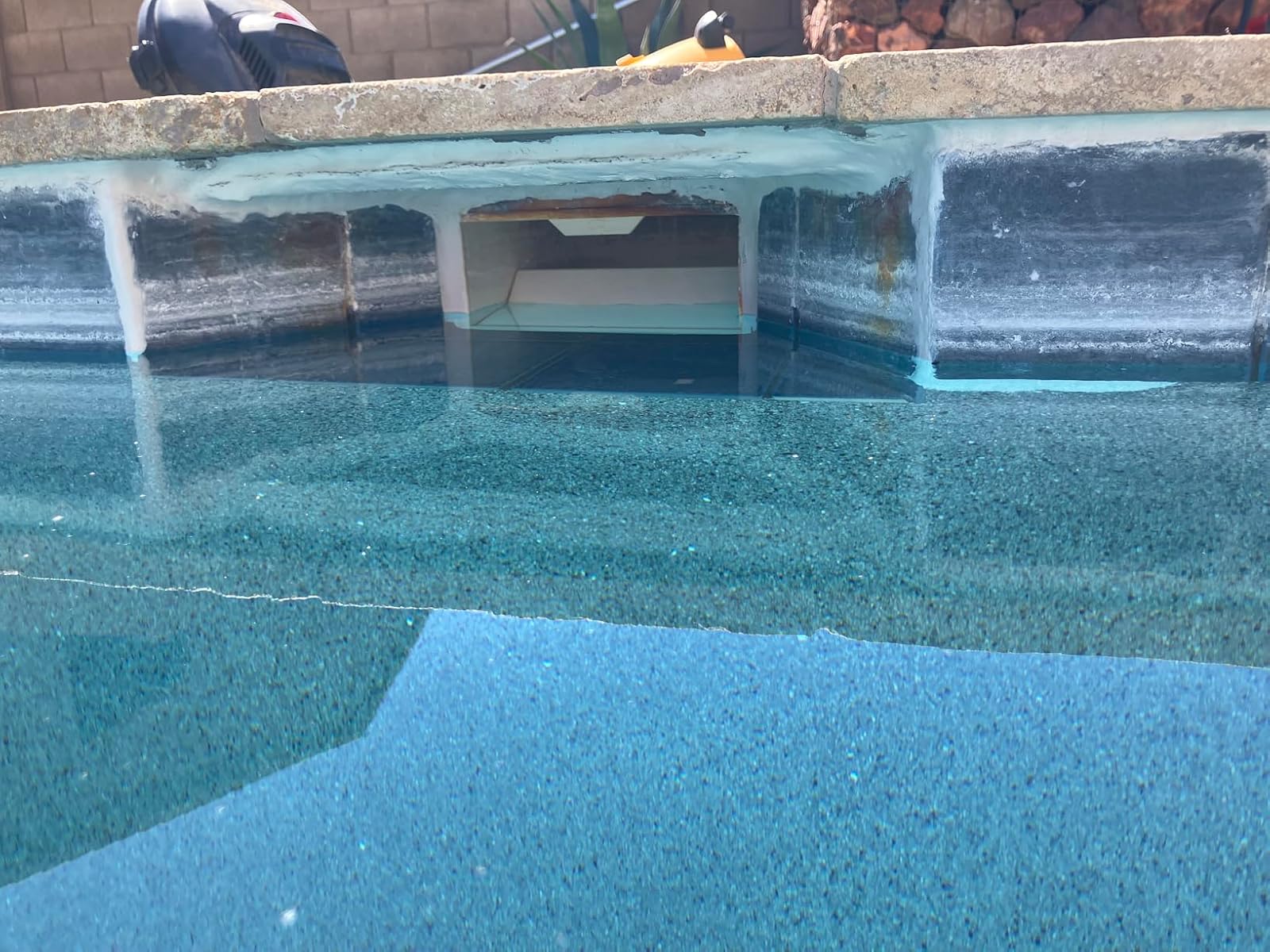
Customer photo from the listing: putty packed around a skimmer mouth with the water left where it was.
Every number here comes off our own data sheets. The first epoxy mortar sold in this country came out of the Mertztown lab in 1949, and we have been mixing repair putties on the same site since 1917. Where the putty is the wrong tool, that is on this page too.
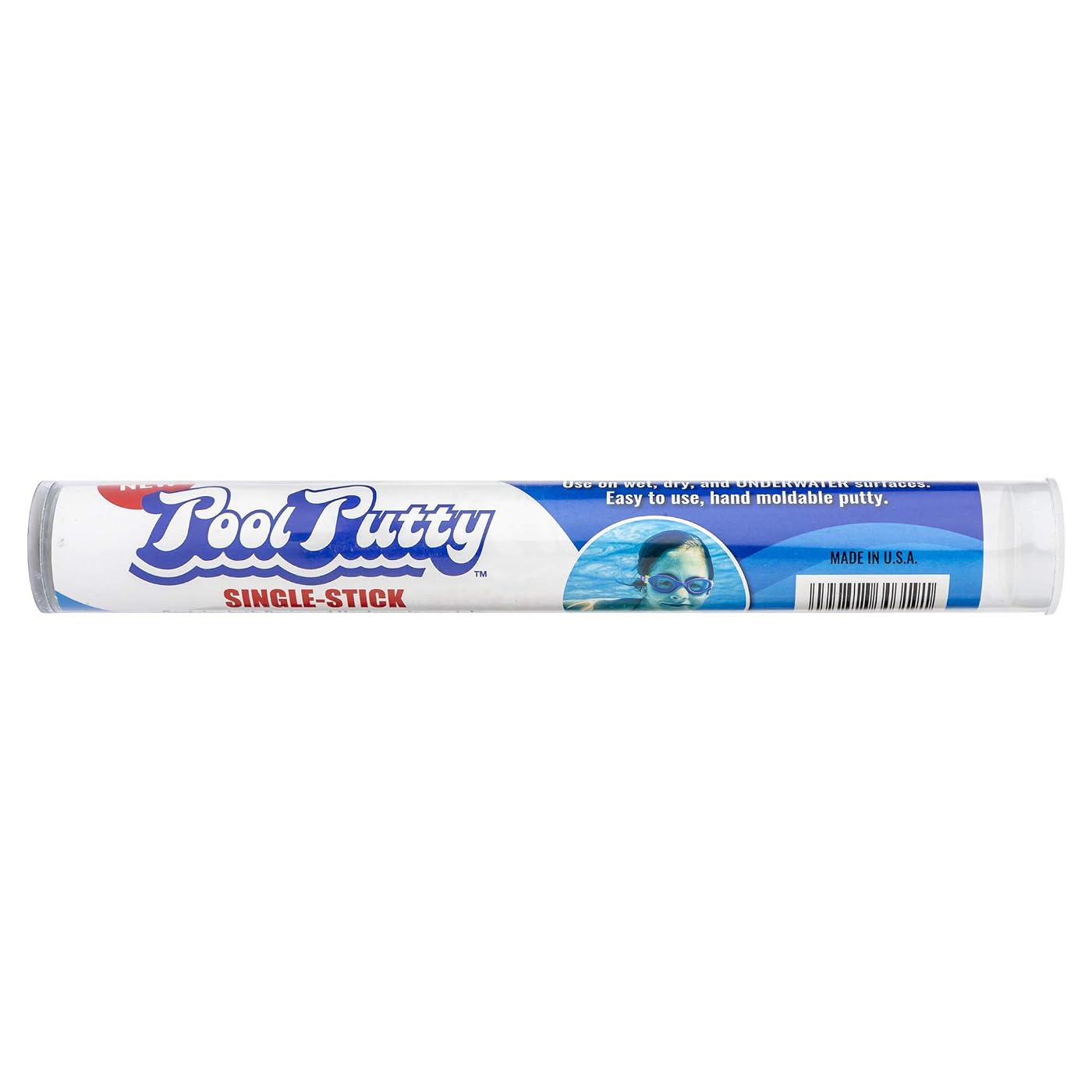
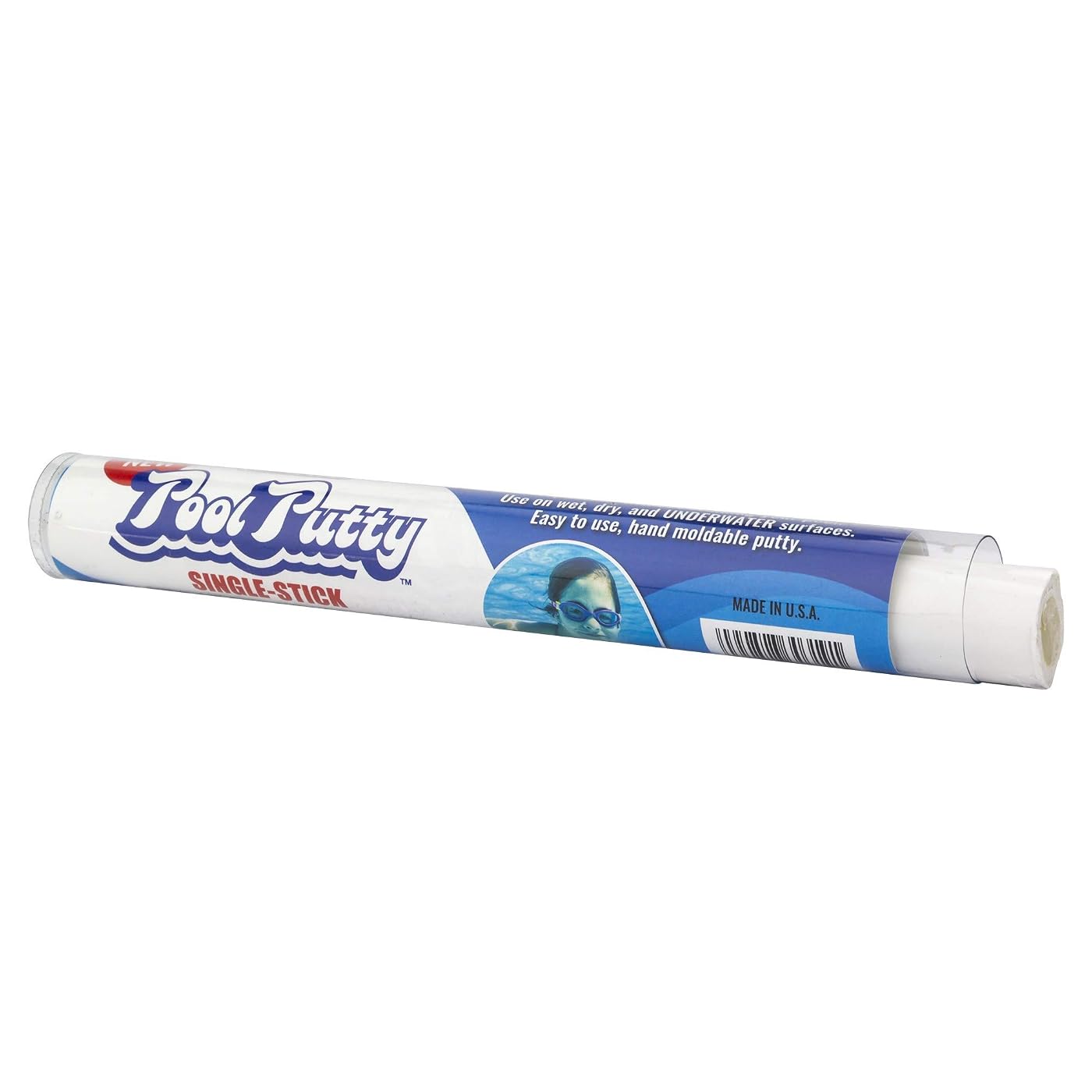
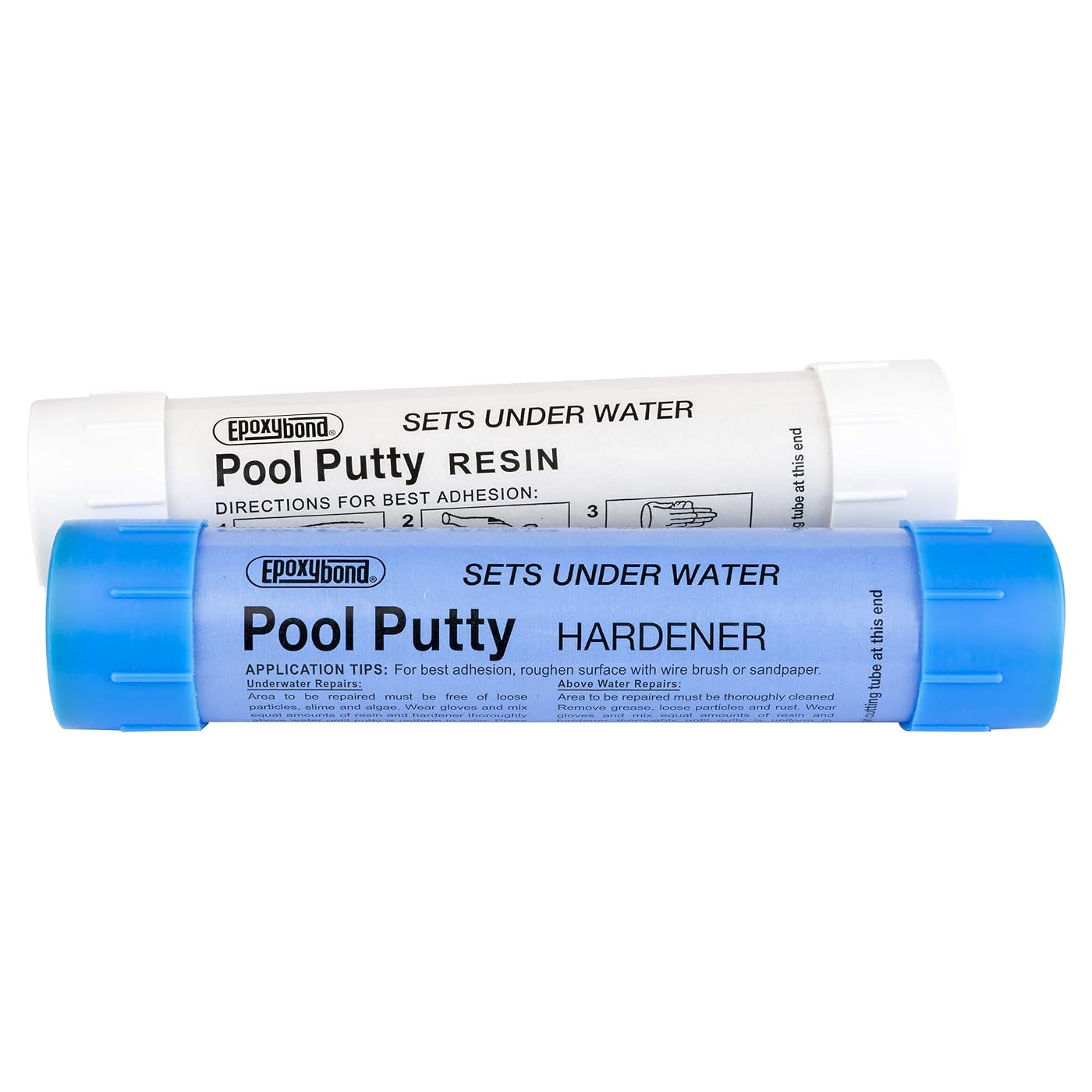
Same chemistry in all three. The sticks put resin and hardener in one extruded rod with the hardener as a core, so a slice off the end carries the right ratio with it. The 2-part set is two 7 oz cartridges you cut equal lengths from.
Cubic inches matter more than ounces here, because a crack is a volume. The 14 oz set yields 11.7 cubic inches of mixed putty. The 4 oz stick yields 3.66. The 2 oz stick yields 1.83.

Hairline cracks, chips, a loose tile, the seam round a light ring. One stick covers a repair of about a cubic inch and a half.

Open cracks, skimmer throats, return fittings. Twice the stick for the jobs where a 2 oz runs out halfway.

Step treads, spa floors, spalled patches bigger than your hand. Two cartridges, cut equal lengths from each.
Prices come from the listing and move without warning. What you see when you land there is what counts.
Two clocks run at once. Working life is how long the mixed putty stays soft enough to shape. Set time is when it stops taking an impression. The sticks give you 5 to 15 minutes of working life and set in 20 to 30 minutes, with full cure in one to two hours.
The 2-part set is slower and more temperature dependent, which is why we publish the whole curve instead of one number. Warm water is not gentler. It is faster, and it will catch you out at the far end of a long crack.
| Water or air temperature | Set time | What that is in a pool |
|---|---|---|
| 60 °F | 3 hours 30 minutes | Spring or a shaded north-facing shell |
| 70 °F | 2 hours | The number the data sheet is usually quoted from |
| 80 °F | 80 minutes | A typical summer pool |
| 90 °F | 55 to 60 minutes | Warm pool, hot deck |
| 100 °F | 40 to 45 minutes | Spa temperature |
| 120 °F | 20 to 25 minutes | Equipment pad in full sun |
Bond strength on the set is rated at 400 psi to concrete. The list below is the substrate side of that, plus the prep each one needs. Every surface wants the same starting condition: clean, sound, and rough enough to key into.
One exception, and we would rather say it here than have you find out in August.
Nothing below needs a pump, a gun, or a mixing tip. Goggles and a pair of gloves cover it. If the repair is deeper than you can reach comfortably, a mask and snorkel beat holding your breath over an open crack.
A hairline you can barely see has nowhere for putty to go. Run a scraper or a grinder along it until you have a channel at least an eighth of an inch deep. That eighth is the minimum application thickness on the data sheet, and a patch thinner than that has no body to hold with.
Wire-brush the channel and a couple of inches either side. Loose plaster, scale and algae film all come off. Underwater, brush slowly so the debris drifts clear instead of settling straight back into the groove.
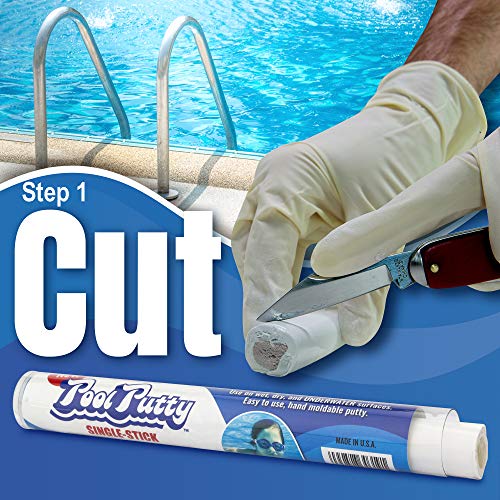
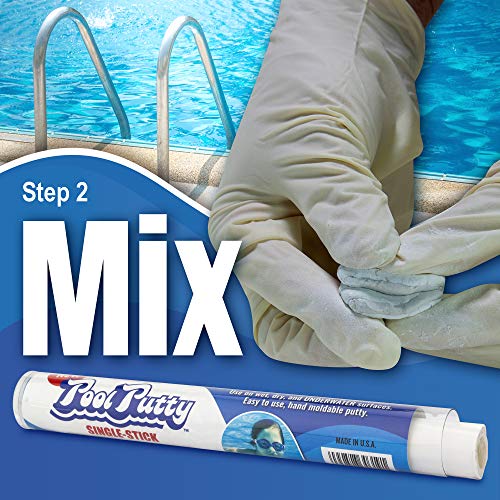
Slice a piece off the stick, or equal lengths off both halves of the set. Knead it in gloved fingers for four to five minutes until there is no marbling left and the color is uniform. Streaks mean unmixed hardener, and unmixed hardener never gets hard.
Roll a rope for a crack, a ball for a chip. Take it down and push it into the channel hard enough to displace the water sitting in there. Work from one end so the water has somewhere to go. Overfill slightly.
Wet-gloved fingers or a small trowel will feather the edge flush. Then stop touching it. Every time you go back to tidy a patch that has started to set you break the bond it was forming.


Cartridge systems in this category sell hard against hand mixing. Messy, they say, and prone to a bad ratio. The mess part is fair. The ratio part is worth a closer look.
A stick carries its hardener as a core inside the resin. Cut across it and the slice holds the ratio the extruder built in, whatever length you cut. The 2-part set is two cartridges of equal diameter, so equal lengths give equal volumes. You are not guessing at proportions, you are cutting them.
Hand mixing has one real demand: four to five minutes of honest kneading. Cut that short and you get a soft patch that crumbles in a month. That is the whole trade.
Pick the damage, the surface, and whether you are going under. It will tell you the size and roughly how many cubic inches the job eats.
Measure the channel after you have opened it out, not before. Length by width by depth in inches gives cubic inches, and cubic inches is the number the packaging can answer.
The result adds 15 percent over the raw void. Some putty stays on your gloves, some gets pressed out past the edges, and running short halfway through a set is worse than having a stub left over.
The technical data sheet says it in four words: not intended for structural applications. Below is what that rules out in a pool.
Nothing on that list is a defect in the putty. They are jobs for a different trade, and a patch that fails in six weeks costs more than the honest answer does now.
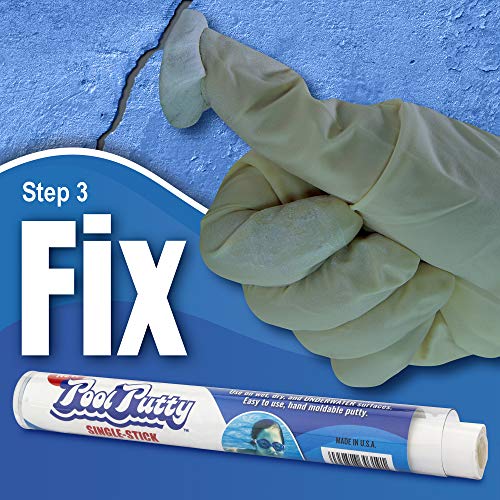
We made this clip, and it is an advertisement. A swimmer, the logo, the line about stopping leaks without draining, and three small tiles reading cut, mix, fix.
What it never shows is a repair. No crack, no hand holding putty against a wall while it stiffens, no skimmer throat. That part is the steps section above and the repair notes below.
Manufacturer video from the product listing, re-encoded smaller for this page. It runs 35 seconds and has sound.
Longer write-ups on the parts that go wrong: temperature, prep, the surfaces that argue back, and the repairs worth handing to somebody else.
Why an empty shell is the riskier option, and the order of work for a repair done with the pool full.
Three different clocks, one temperature curve, and the mistake people make quoting the 70 degree number in August.
Prep for each substrate, and why gelcoat is the surface people skip preparation on.
Yes, that is what the formulation is for. The putty displaces water as you press it into the channel and cures submerged. Draining a pool to reach a crack brings its own risk, since an empty shell in wet ground can float or crack further.
Mix above the water, then take the mixed putty down. Kneading underwater traps water in the mix.
The sticks set in 20 to 30 minutes and reach full cure in one to two hours. The 2-part set follows the temperature table on this page, from 20 minutes at 120 degrees F out to three and a half hours at 60.
Set means it no longer takes an impression. Give it the full cure window before anything scrubs or presses against the repair.
On aged plaster, yes. The cured putty is white and older marcite has drifted gray or tan, so the repair reads lighter for a season until it weathers in.
The listings describe the sticks as yellow. Cured color is white, and it is formulated to hold that color rather than yellow with age.
Once fully cured, yes. Sand it flush, clean the dust off, and treat it as you would the surrounding substrate. The set carries 8,000 psi compressive strength, so it takes a tile bed without moving.
A rigid epoxy on a membrane under tension is a mismatch. The liner keeps flexing with temperature and water level, the patch does not, and the bond opens at the edges. A vinyl patch kit is the right tool, and we do not make one.
The sticks are rated for continuous service from minus 40 up to 250 degrees F, and 300 degrees F intermittently. The 2-part set is rated to 150 degrees F continuous and 200 intermittent.
Pool and spa temperatures sit nowhere near those limits. The numbers matter when the same putty goes on a hot water line or an equipment pad.
Shelf life on the 2-part set is twelve months. Reseal what you cut from, keep it out of direct sun, and check that the material still kneads soft before you rely on it for a repair.
Atlas Minerals & Chemicals in Mertztown, Pennsylvania. The company was founded in 1892 grinding red shale for pigment, moved to Mertztown in 1917, introduced the first epoxy mortar sold in the United States in 1949, and has been owned by its employees since 1978. The pool putty tubes came first. The Single-Stick format arrived in 2021 for smaller repairs.