Most calls to our plant in Mertztown about slow setting come in May, and most complaints about putty setting up in the hand come in August. The data sheet sitting on your workbench lists figures measured at standard lab conditions. Once you step out to the pool deck, the thermometer dictates what the resin actually does.
Working time, set time and full cure are three different milestones on one continuous chemical reaction. Heat accelerates that reaction, and cold slows it down. If you quote the 70 F numbers while kneeling over a hot spa or mixing on sunny concrete, the putty will catch you off guard.
The three clocks and what each one means
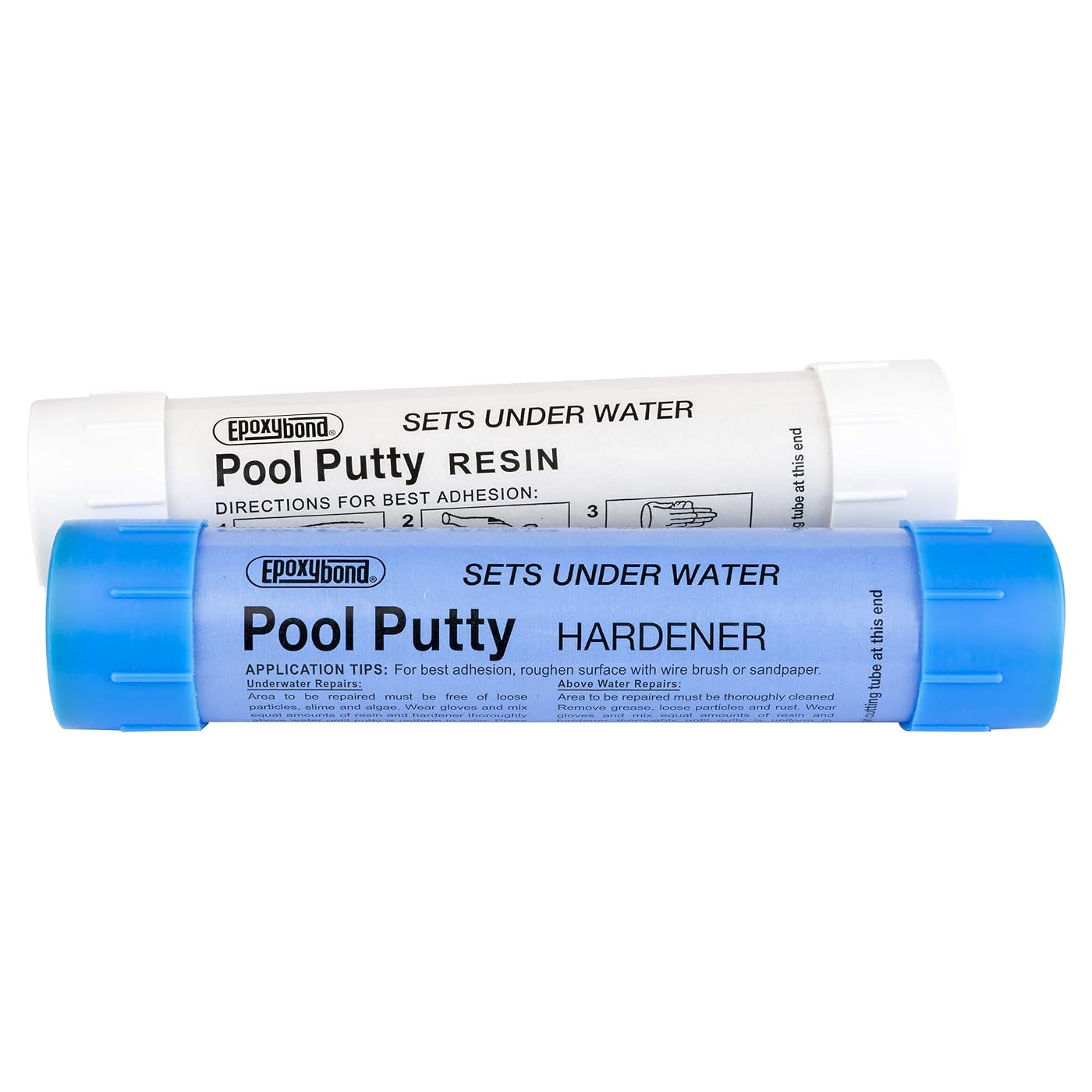
Working time is the window between completing the mix and placing the material. During this stage, the putty stays soft enough to wet out plaster, concrete or abraded PVC without tearing. For our Single-Stick putty, working life runs 5 to 15 minutes at room temperature. For the 14 oz set, mix thoroughly on the deck for four to five minutes until the streakiness vanishes, then get it straight to the repair site.
Set time marks the point where the mass turns firm to the touch. It will no longer flow or accept thumbprints, but the internal crosslinking is incomplete. The 14 oz two-part set reaches this stage in 2 hours in 70 F water. Do not try to smooth or feather the edges once set begins, or you will break the developing bond.
Full cure means the polymer network has reached its ultimate mechanical properties, including its 8000 psi compressive strength. On the sticks, full cure takes 1 to 2 hours under standard conditions. On the 14 oz set, it needs a full overnight window before facing heavy physical loads.
How water temperature shifts the numbers
Water carries heat away from or into an epoxy patch far faster than air. That makes water temperature the controlling factor for any submerged repair. In 60 F water, the 14 oz set takes 3 hours 30 minutes to set. Raise the water to 80 F and that time drops to 80 minutes.
Hot water speeds things up dramatically. In a pool running at 90 F, set time falls to 55 to 60 minutes. In a 100 F spa, you have 40 to 45 minutes, and at 120 F the set occurs in just 20 to 25 minutes. If you treat a warm tub like a 70 F swimming pool, the putty will harden before you finish tooling the joint.
Handling the heat on the deck
Your hands and the pool deck add heat before the mixed ball ever touches the water. Kneading the material generates friction, which kickstarts the reaction early. On a hot summer afternoon, mixed putty sitting on flagstone can kick in half the expected time.
Never mix more putty than you can place in five minutes. If you have a large repair, cut smaller sections and apply them in batches rather than trying to place a whole pack at once.
Mix only what you can press into place immediately. Carry it underwater promptly, push it firmly into the prepared joint to displace the water film, feather the perimeter, and leave it alone.
When changing water temperature will not help
No amount of temperature adjustment makes epoxy work on the wrong substrate or the wrong kind of crack. Our data sheet states plainly that this material is not intended for structural applications. If the pool shell has cracked because the ground shifted, putty will not hold it together.
- Vinyl liners move constantly with temperature and water level, which breaks the rigid epoxy bond at the edges.
- Pressurized pipes force water behind the patch before it can establish a set.
- Active expansion joints require flexible sealants because pool putty cures hard.
- Fittings made of PVC or fiberglass need aggressive mechanical scuffing first, or the chemical will not grab.
Cut equal lengths from the 14 oz cartridges or take a slice straight across the Single-Stick, knead until the color is uniform, and place it at a minimum thickness of 1/8 inch. Check your water temperature before you start mixing, because the resin will follow the water thermometer every single time.