Most pool leaks that get blamed on concrete turn out to be penetrations. The gunite shell or plaster coat rarely splits on its own without a structural shift behind it, but every skimmer throat, return eyeball, and light niche is a joint between two materials that expand at different rates. Water finds the cold joint where plaster butts against molded PVC, cast bronze, or galvanized steel.
When that interface pulls apart, water drops down behind the shell. Our plant in Mertztown has fielded letters about leaking penetrations since we introduced the Epoxybond line, and the fix is almost always sealing the annular gap around the fitting rather than smearing epoxy over the face of the plastic.
Identifying the gap at the fitting
A penetration leak rarely shows as a wide crack. It is usually a hairline hairline separation right where the plastic or metal collar meets the surrounding plaster. The plaster cures against the smooth outer body of a skimmer throat or return fitting without creating a true chemical bond. Over several seasons, vibrations from the pump and standard ground movement work that seam loose.
Check the bottom corners of the skimmer mouth first. Ground settlement drops the deck slightly, twisting the plastic housing while the pool wall stays put. That puts the joint into shear. If dye tests pull into the perimeter seam, the joint needs to be raked open and repacked.
Preparing the dissimilar surfaces
Epoxybond Pool Putty adheres to gunite, marcite, pebble finishes, ceramic tile, and PVC. But smooth plastic fresh from the mold has slick release agents and no tooth. If you press mixed epoxy against glossy PVC, it will stick until the first cold snap and then pop free in one piece.
Scrape the joint with a small chisel or a painter tool until you have an open channel at least 1/8 inch deep and 1/8 inch wide. The 2-Part Set requires a minimum application thickness of 1/8 inch to develop its 400 psi bond strength to concrete. Clean the plaster edge back to sound material with a wire brush. Scuff the plastic sleeve or metal housing with 80-grit abrasive paper until every trace of gloss is gone.
Packing the throat and niche joints
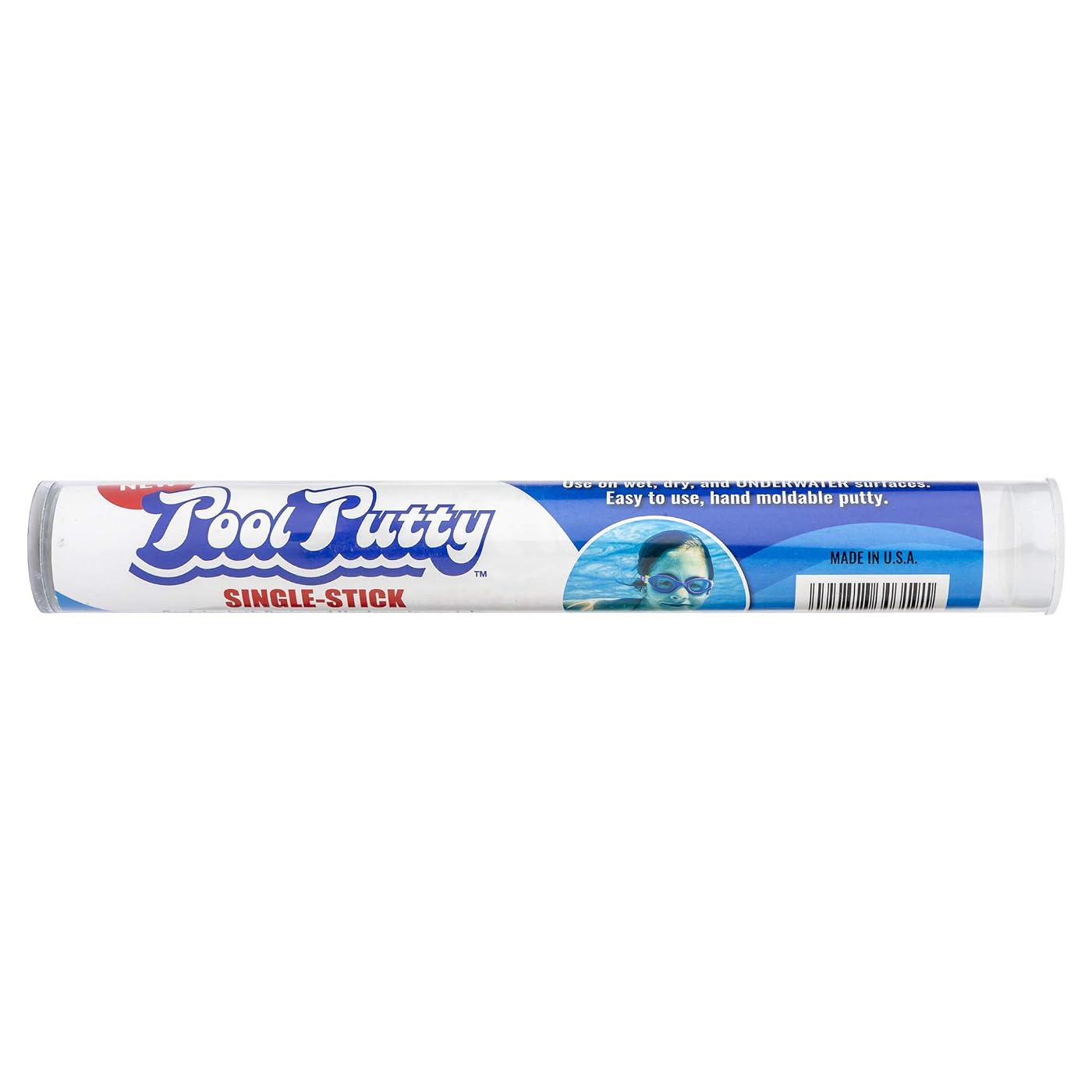
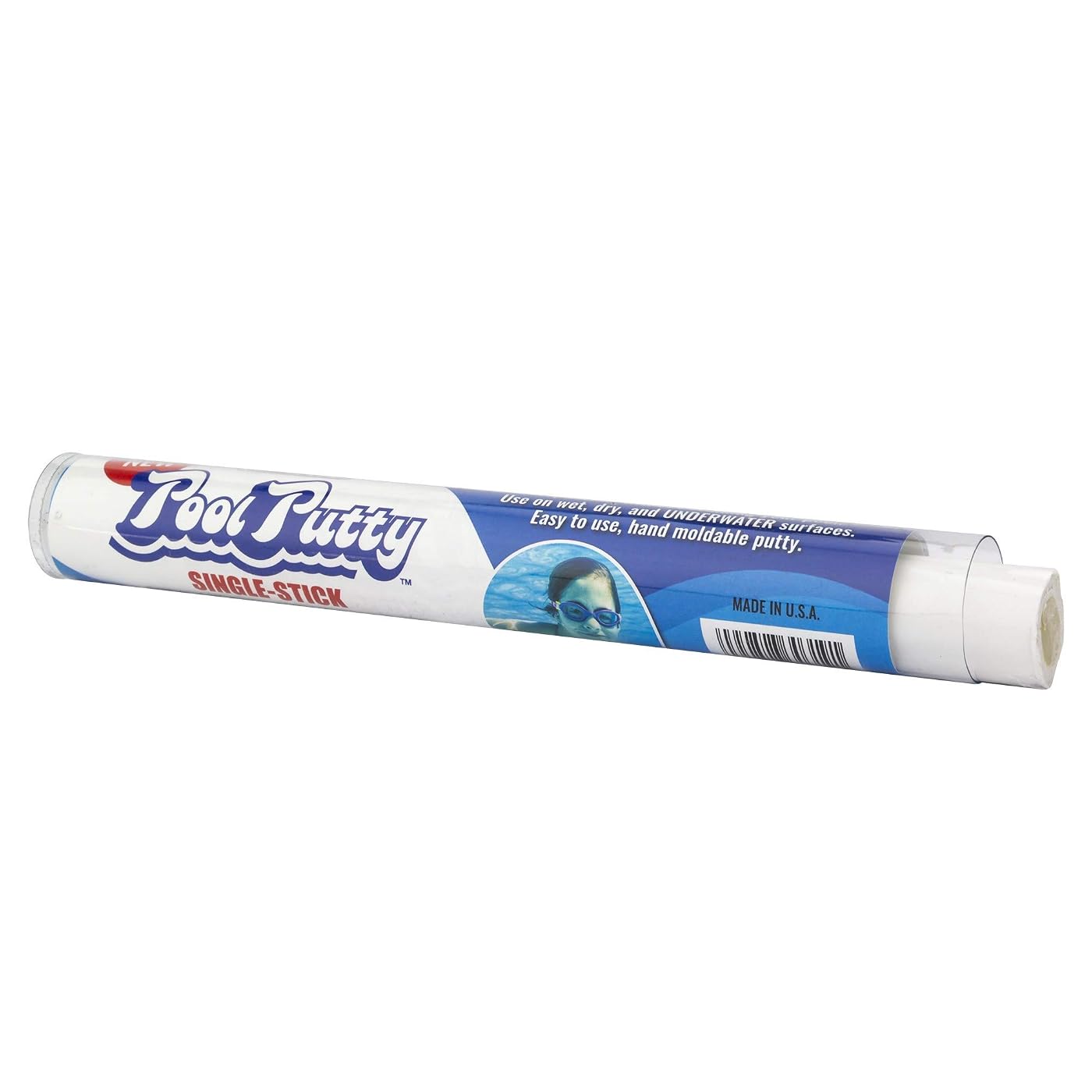
Mix your putty on the deck. If you are using the 2-Part Set, cut equal lengths from the resin and hardener cartridges. If using a Single-Stick, cut a slice straight across the stick to keep the built-in ratio intact. Knead the material between your fingers for four to five minutes until the color is uniform with no streaks or marbling.
Roll the mixed putty into a pencil-thick rope. Take it underwater and start packing it into the prepared groove from one side to the other. Do not bridge over a void: push the putty firmly into the seam so it displaces the water film and keys into the textured plaster and scuffed plastic. Leave the bead slightly high, then feather the edge flat against the wall with your thumb.
Epoxybond Pool Putty cures fully submerged, but it is not intended for pressurized pipe interiors. Do not attempt to seal a cracked return line from the inside while the pump is running; water pressure will blow the soft putty out before it cures.
Working times and curing speeds underwater
The putty hardens by an exothermic chemical reaction. Water temperature controls how fast that happens. In an 80 F pool, the 14 oz 2-Part Set gives you an 80-minute set time, reaching full firmness in about two hours. In cold water around 60 F, that set time extends to 3 hours 30 minutes. If the water is 90 F, you have 55 to 60 minutes before the mass stiffens completely.
The Single-Stick format offers a faster working life of 5 to 15 minutes, sets in 20 to 30 minutes, and reaches full cure in 1 to 2 hours. Once you have placed and feathered the bead around the light niche or skimmer throat, stop touching it. Agitating the compound while it enters its initial set breaks the polymer chains and ruins the bond.
Situations where putty will not work
We make rigid epoxy systems. Our mixed putty has a compressive strength of 8000 psi and roughly 1 percent shrinkage. It cures hard as rock. That makes it dependable for locking rigid fittings into rigid masonry, but useless for flexible materials or dynamic movement.
- Vinyl liner penetrations: the flexible liner expands and contracts constantly under water tension, which will peel a rigid epoxy bond right off the face.
- Structural expansion joints: the mastic joint between the pool coping and concrete deck is designed to move, and packing it with epoxy will crack the deck.
- Cracked pipe walls deep inside the plumbing run: if you cannot reach the pipe wall to clean, abrade, and mechanically pack an 1/8 inch layer, putty cannot seal it.
If you are sealing a brass or stainless light niche, wire-brush the metal down to bright surface before packing the collar seam. Oxides and algae prevent proper adhesion, and a bead pressed over green copper tarnish will fail as soon as the ground shifts.